Lisa Hendrix

Myth. Magic. And the power of love.

Archive for the ‘Research’ Category

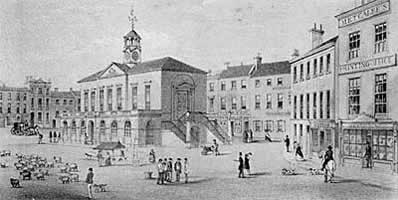
A stop at the Retford market

Posted by Lisa Hendrix on September 24, 2009
Posted under Locations: Immortal Outlaw, Research, Wanderings

Sorry I’ve been so delinquent about continuing our travels through Nottinghamshire. It’s been a busy couple of weeks, what with driving Child1 to college nine hours away, then turning around 24 hours after I got home to make the ten hour round trip to a signing in Portland. I barely got back from that in time to attend Child2’s acting debut, literally walking in just as the play began. And then two days after that, I started running a character workshop for the FF&P Chapter of RWA. Whew!

But things have settled down now, sort of, so we’re off again, backtracking, as Steinarr and Marian did, from Haworth toward Sudwell, stopping off at the Retford market. This is the market where Ari sat in the tavern and spun the story that inadvertently started the rumors about Robin Hood.

Retford, which lies on the River Idle about 30 miles north of Nottingham, has long been the prinicipal market town in an area known as the Hundred* of Bassetlaw. Ret-, or Red- (the town appears in the Domesday Book as Reddeforde), is a reference to Read the rest of this entry »

In pursuit of Steinarr and Marian

Posted by Lisa Hendrix on July 16, 2009
Posted under Locations: Immortal Outlaw, Research, The Books

From the time I started IMMORTAL OUTLAW, I intended to take you all on a tour of the locations  in the book and reveal the fact and fiction in the story.  However, I didn’t want to post too much too soon and end up with spoilers.

The book has been out about 6 weeks now, so I think it’s safe to begin our trek. First though, a bit about a question I’ve gotten over and over during the past couple of months:

Why Robin Hood?

Well, why not? It’s a story that has been around for at least 600 years, so it clearly resonates: A good man outlawed for either an unfortunate mistake (accidentally killing a forester) or for standing up to tyranny (refusing to do homage to a usurper trying to steal the throne) depending on the version you’re reading, making his way in the wilds, gathering a band of like-minded men around him to redress the wrongs of society by robbing only the rich to aid the poorest around them. Bows and arrows, horses, great chase scenes through the woods, comic relief, and a love for the ages. Great stuff, even if it’s likely based on the romanticized story of a tax-evading scofflaw.

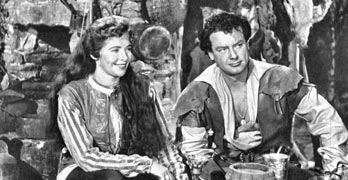
But really why are these two:

greene_ofarrell

That’s Bernadette O’Farrell as Marion and Richard Green as  Robin from The Adventures of Robin Hood, an ITV series rebroadcast in the US on CBS. I grew up on these two (and Patricia Driscoll, who took over the role of Marion, as they spelled it, in seasons 3 and 4). [Photo used without permission.]

I watched TARH in syndicated re-runs, and I loved it from the first. I fantasized about being Marian, who in the series was brave and bold and every bit as good with a bow as Robin. No victimized Olivia de Haviland here. She was a tough cookie (and even tougher after pixie-like Driscoll took over), and she fought the bad guys alongside the men. This was probably because the producer was Hannah Weinstein, one tough cookie herself (she hired blacklisted writers like Ring Lardner to write episodes under psuedonyms, which explains the solid, socially conscious storylines).

As a bonus, bits of the series were shot on location in the meadow at Runnymede where the English barons—including a descendant of the real Ivo from Immortal Warrior—forced King John to sign the Magna Carta. The production values on TARH were pretty high for the time (it was shot on 35 mm film), so even now, some 50+ years later, the images are crisp. You can find the DVDs at Amazon (all four seasons/143 episodes for under $25).

So, yeah, Robin Hood, and not for the first time. My first published romance, Hostage Heart, was totally Robin Hood gone cowboy, a straightforward western version of the legend complete with robber-cattle-barons and unsavory sheriffs—unlike this one, which is my fantasy about how such a story might have come about if our boy Ari had been around.

I hope you’ll follow along as we retrace Steinarr and Marian’s zig-zag route through Nottinghamshire. You’ll be able to see their path on the interactive map available from my Extras page or at GoogleMaps. Invite a few friends to come along. It’s going to be an interesting ride.

So, what was your favorite version of Robin Hood (book, movie, or tv)? Did you ever dream of going outlaw for the sake of justice? Were you a fan of Little John, Alan-a-Dale, or Will Scarlet?

UP NEXT: The Road to Maltby

Summertime, Summertime

Posted by Lisa Hendrix on July 15, 2009
Posted under Kvetching, Life Life, Research, The Books, Wanderings

Ah, the joys of summer. Lazy days, hammocks under the maple tree,  corn on the cob, poison ivy…

Wait. I live in southern Oregon. We have poison oak, not poison ivy. Everyone knows that. Well, everyone except the bird that apparently flew in with a gut full of poison ivy seeds and planted them in the pachysandra.

A while back, I noticed we had some new plant growing in the front side yard, between the mulberry and the cherry. It was pretty and green, and other than a vague idea that I needed to figure out what it was, I didn’t think much of it at the time. Then I got that debilitating crick in my neck I mentioned and wasn’t doing much of anything, particularly gardening, so the pretty green plant grew and spread, looking quite lovely in the shade and filling in a bare patch in the ground cover that needed something anyway.

Then my neck got better and I went out to take a closer look. Leaves of three. Oh, crap. The leaves weren’t shiny, like I remember from summers in Kansas, but I knew.  I came in and fired up the laptop just to check.psn-ivy-in-pachy

We’ve got poison ivy, a patch about 10′ x 15′ that bleeds into the pachysandra and the lilies of the valley (also poisonous, btw, but not in quite the same way). I scooted off to buy Tecnu and Marie’s Poison Oak Soap, and then hubby and I geared up for the attack. But the woody root is well buried in the pachysandra and intertwined with those of the mulberry, and it quickly became obvious we were never going to succeed that way. So hubby headed off to the armory (garden store) while I scrubbed the tools with Technu. (Here’s a great site with info on poison ivy, how to recognize it, and what to do about it.)

Thank goodness Steinarr and Marian (IMMORTAL OUTLAW) didn’t have to worry about poison ivy (imagine that scene under the tree at the collier’s camp if they discovered they’d been sitting in the wrong plant!), It’s not native to England,  but unfortunately, modern English practitioners of love al fresco have to look before they lie. The plant is so beautiful in the autumn that some fool brought some in to enhance his garden. Somebody, presumably, immune (about 1 in 4 is, although that can change with continued exposure).

The bird that made us a gift of the seeds was likely a downy woodpecker, who loves the creamy white berries. I’ve seen way more woodpeckers in the neighborhood than usual this year, including one I think was a downy. But it could have been anything, because the only beasts NOT immune to poison ivy are primates — like us. So there you go.

Anyway, chemical warfare has been launched. Leaves are beginning to wilt (not to include the mulberry or cherry, we hope). We’ll still have to grub up the roots this fall while wearing exposure suits, but at least we’ll know they’re dead when we do. And then we’ll have to replant. Something pretty and green…and non-toxic.

We’ve avoided rashes so far, but I bet some of you haven’t.  Care to share your itchy story? Got pix?

Lisasigpink

Make your own Viking spoon

Posted by Lisa Hendrix on August 19, 2008
Posted under Research

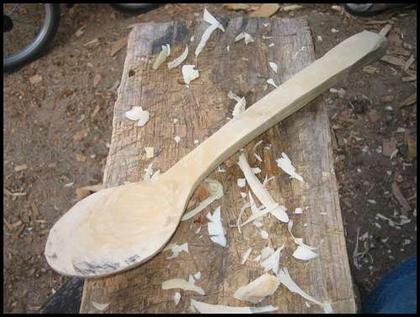
Okay, maybe not.  But here’s someone who did, and it’s fun to see how he did it. Since there’s a scene in IMMORTAL WARRIOR in which the the serfs at Alnwick spend a rainy day in the hall making spoons, I was interested to see this authentic recreation of the process, and I hope you are, too.

Viking style spoon

When I was a kid, I was so jealous of my older male cousins and their pocket knives that I nagged my Grammie into giving me one.  I immediately started “whittling” — not well, but enthusiastically, and there’s still a part of me that wants to carve something wonderful from wood.  (Note to self: Add to Life List)

How about you?  Did you ever carve/whittle?  What did you want to do as a kid that you haven’t done yet?  Have you put it on your Life List?


Lisa


(via Boing-Boing)

PS:  Okay, I’m going to come clean.  I originally went to Boing-Boing’s post because the title that came up on my RSS feed was “howto-make-a-viking.” Now there’s a worthwhile project…

Is it that time again already?

Posted by Lisa Hendrix on July 25, 2008
Posted under Research, Writing Life

Apparently so.  Today is my regular monthly blog slot at Rose City Romance Writers.  The topic of the month is research, which could be boring, but has turned out not to be at all.  What’s most interesting to me is how differently each person approaches both the topic and the research itself. Pop on over and check it out. I promise we won’t bite.


Lisa

The greening time

Posted by Lisa Hendrix on June 21, 2008
Posted under Muse, Research

Did you know that the low hanging, large, reddish moon that would be called a Harvest Moon in late September/Early October is called a Strawberry Moon when it happens near the solstice? 

The summer solstice was yesterday, June 20, at 7:59 PM EDT, so I thought I’d do a quick roundup of  ways some folks mark this longest day of the year.


Traditional

Flowers: Gathering nine different types of flowers and placing them under your pillow on the solstice is supposed to make you dream of the person you will marry. Nine is a number sacred to the old Nordic and Saxon gods (which is why there are nine Vikings in my crew of Immortal Warriors.)

Weddings: Druids celebrated the summer solstice as a marriage of heaven and earth, which is why June is the month for weddings

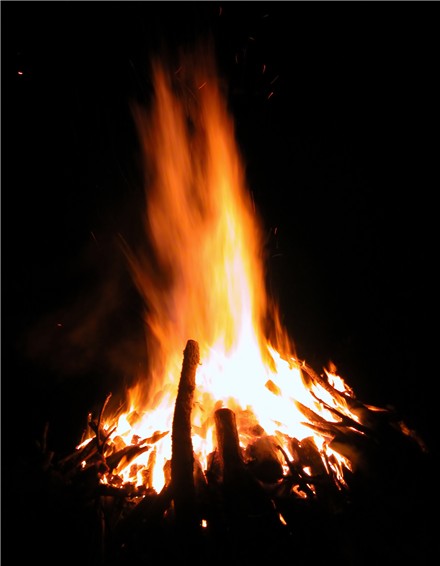
Bonfires.  In Cornwall in the old days, every peak and hall glowed with light on Midsummer Eve as the fires begged the sun not to retreat into winters darkness.

Spirals:  Ancient solar dances would spiral in to the center and back out again, representing the path of the sun.

Herbs: Practioners of herbal magic believe that herbs gathered at the solstice are imbued with extra potency.

Stones: Tracking the sun was immensely important to early people, so they knew when to plant and harvest and when to honor their gods—so important that they would spend years building what amounted to giant stone calendars. Stonehenge is the most famous of these, but Machu Pichu, New Grange, the Sun Dagger of Chaco Canyon, and dozens of other stone sites around the world served the same function.


Modern

Parades: Seattle’s Fremont District (The Center of the Universe) holds a fair and a wild parade to celebrate the solstice and the amazing energy of the neighborhood. 

Nativity of St. John the Baptist:  This Christianized version of the solstice marks the birth of this important saint (unlike most feast days, which celebrate the martyrdom of the saint).  Particularly important in northern and eastern Europe and the celtic countries (where the solstice was also key), it is one of the most solemn of Catholic holy days, even celebrated when it falls on a Sunday (also not typical for a saint’s day).

Picnics and Bonfires: In Denmark and other countries, Midsummer is marked by spending much of the day outside, ending with a nice bonfire on the beach.

Stones: In the tradition of the great ancient builders, my husband recently put the item “Stonehenge” on the whiteboard that his team uses to keep track of projects at work.  Yesterday, he assembled his personal mini-Stonehenge kit (carefully aligned, of course) and crossed the item off the list. No one noticed. Sigh.

He intends to do it again in December anyway.

How do you celebrate Midsummer?


Lisa


Two wondrous things

Posted by Lisa Hendrix on June 20, 2008
Posted under Muse, Research, Wanderings

Photo from Smithsonian Flickr collectionFirst, there is water on Mars. (Link to Wired article with nice image showing ice chunks subliming.)

Second, the Smithsonian now has their photograph collection up on Flickr Commons, with all photos hi-res and tagged as “No known copyright restrictions.” (Link)

Things like this give me hope. 


Lisa

Another Great Medieval Resource

Posted by Lisa Hendrix on December 17, 2007
Posted under Research

Back to the research track with the Internet Medieval Sourcebook — Fordham University’s online repository of original medieval era documents in the original languages and in translation, plus links to other repositories. Everything from Church documents, philosophy and spiritual thought, early Islam, government/legal/medical documents, and literary texts in major European languages –including Norse sagas, a couplet-rhymed translation of the Song of Roland, the Robin Hood texts, Canterbury Tales, several translations of Beowulf, etc. There’s nothing quite like reading source material.

Lisa

Planetary Wonder

Posted by Lisa Hendrix on December 9, 2007
Posted under Muse, Research

There’s more to Google Earth than finding a satellite view of your house — which is cool enough — or even seeing the land where your characters walk. You can also find the altitude of any particular spot just by rolling the pointer over it or use the ruler to measure distances from point to point. Optional links (which show as dots on the photo) take you to Read the rest of this entry »

One Final, Excellent Timeline

Posted by Lisa Hendrix on December 8, 2007
Posted under Research

TimeRef.com — a wonderful interactive timeline of the Middle Ages. Approaches the era both chronologically and as “Episodes”, which break down specific incidents. Includes thorough listings of medieval people and places, plus 3-D Virtual Reconstructions of buildings as they may have appeared in the past (you can visit London Bridge, or see Warwick Castle in 1070 and 1260 and make comparisons). Use their Timeline Wizard to generate timelines of events for a given date range, related to selected people or based on various criteria, or select My Project to organize information around a specific subject and then generate a useful reference report and timelines.

Snazzy.

Lisa

Switch to Day Switch to Night