Lisa Hendrix

Myth. Magic. And the power of love.

Archive for August, 2009

The Priory of Kirklees

Posted by Lisa Hendrix on August 30, 2009
Posted under Locations: Immortal Outlaw, My Heroes, Writing Life

Left nearly powerless by the wounds she received during the battle at the end of Immortal Warrior, Cwen the sorceress found refuge in the nunneries of England, eventually ending up at Kirklees, a Cistercian priory in the forests of what was traditionally known as the West Riding of Yorkshire. There, she worked her way up to Prioress (second to the Abbess), and that’s the point where we meet her again in Immortal Outlaw.

Saint Alice of SchaerbeekThe Cistercians are an order of enclosed monks founded by St. Roger of Molesme in 1098 at Cisteaux, France. They were strict followers of the Rule of St. Benedict, which called for vows of poverty, chastity and obedience, and dictated self-sufficiency and a simple life that included manual labor (St. Bernard was another famous founding member of the order.) Women were admitted to the order almost immediately, with the first nunnery opening at Langres in 1125. The nuns were known as White Ladies because of their white robes. I’ll confess right here that I screwed up on this point and talked about how Cwen liked her black robes, because they honored the old gods from whom she draws her power. Oops. I didn’t catch the mistake until well after galleys were done, and strangely, my usually perfect copy editor  didn’t catch it either. However, in our favor, the nuns did wear a black hooded surplice over the white robes (as in the image of St. Alice of Schaerbeck to the left). Perhaps we can both be forgiven.

Kirklees was founded in 1155, during the reign of Henry II,  with the grant of land confirmed in 1236 by Henry III. In addition to nuns, the house was used as a sort of boarding school by local noblemen intent on keeping their daughters out of trouble. This effort had mixed success: the young noblewomen brought luxuries and a sense of fun with them that sometimes spread to the nuns, and there are several recorded incidents when nuns ran off with priests or otherwise carried on scandalously, sometimes right on priory grounds; those stories inspired both Cwen’s magic-weaving in her cell and the story of Sr. Paulina and Fr. Renaud and their clandestine affair.

old photo Kirklees

Kirklees escaped the initial rounds of the Dissolution in 1535, but was eventually surrendered in 1539, when only eight nuns remained. After the inmates left, the chapter house was razed and its stones eventually were used to build Kirklees Hall nearby. However,  the gatehouse escaped the predations and still stands today, though parts were apparently rebuilt in the intervening centuries.In the traditional Robin Hood legends, it is in that same gatehouse that Robin meets his end, bled to death by his cousin, the prioress of Kirklees, whom he sought out when ill. When he realizes his cousin has betrayed him, Robin summons help with his hunting horn. It’s too late, however, and all Little John can do is help Robin shoot an arrow out the window, promising to bury him on the spot where it fell.

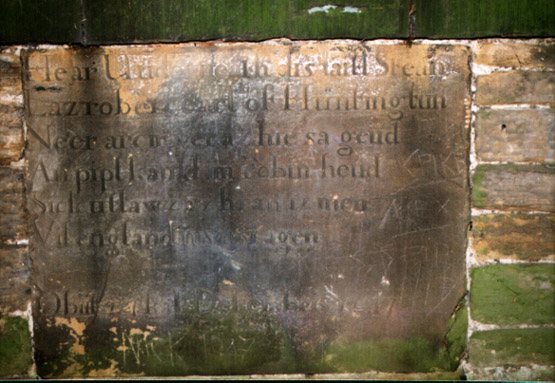
Robin's headstone

A well-marked grave exists at Kirklees today, surrounded by an iron railing and showing a Victorian era headstone in pseudo-Gothic  English that claims it’s where Robin lies. Suspiciously, it lies a good 600 yards from the gatehouse — over twice the distance of a good medieval longbow shot. However, travelers to the area during the mid-16th century report visiting Robin’s grave in a different place, at about the right distance for a bowshot. And indeed, human remains were found in that spot during renovations of Kirklees Hall during the mid-18th century. It’s unclear wherther those remains were reburied at the spot now marked for Robin.

The Victorian headstone, pictured, reads:

Here underneath dis laitl stean
Laz robert earl of Huntintun
Ne’er arcir ver as hie sa geud
An pipl kauld im robin heud
Sick utlawz as his as iz men
Vil england nivr si agen

Whether Robin lies in the marked grave or not, both locations sit on private land, inaccessible to  the public. Somehow, I think it’s appropriate that Robin remains as elusive to us today as he was to the Sheriff in the 13th century.
Lisasigpink

Next up on the tour:  The village of Harworth

The Lady Well at Headon

Posted by Lisa Hendrix on August 14, 2009
Posted under Locations: Immortal Outlaw, Wanderings

First, two announcements:

  1. I’m signing IMMORTAL OUTLAW tomorrow, Saturday, August 15, at the Barnes & Noble in Medford, OR (4pm). If you’re in the area, bring every live human you can lasso and come for fun, games, and giveaways.
  2. My first ever book video is up on the Books page. Skip over, watch it, and then come back. I’ll wait.

(humming…)

Back?  Good. On to our next stop:

When medieval people located an especially fine or clear spring, they often dedicated it to the Virgin Mary (the Lady). Thus, the lady wells that dot England and Scotland. There are especially famous lady wells in Lewisham (London) and Glasgow.

lady_well

The lady well featured in IMMORTAL OUTLAW lies at the foot of a rise north of Headon, a tiny village in Bassetlaw, the northernmost district of Nottinghamshire. It’s a real well, documented in both the name of a road—Lady Well Lane, which passes by Nether Headon—and on the UK Megaliths website. (Unfortunately, the latter is down as of when I’m writing this. If it comes back online later, I’ll provide a link to the correct page.)

You’ll have to squint at the accompanying thumbnail photos (the larger pictures I intended to include vanished along with the Megaliths site), but you can see that there is indeed a hill behind the well, though I couldn’t find a photo of it, and it wasn’t that clear in Google Earth, either. Not that it would have looked the same as it did at the end of the 13th century anyway. Thus, my supposition of a boulder and a snag on top that could have made a stag’s head is, well, supposition. Imagination. Licentia poetica. I do make my living writing fiction…

headonwelldress2000closerjpg

The lady well was ‘dressed’ in 2000,  i.e. enclosed by the fancy new brick surround you can see at the right (squint again), continuing a tradition of enclosing such wells to preserve them and to honor the Lady.

Although Headon manor was listed in the Domesday book as Hedune, it’s difficult to find any historical information about it. Or any current information, for that matter. However, you can find a set of photos of the area, HERE, including a picture of the manor (much later construction) and the 12th & 14th c St. Peter’s Church, the chapel in which Cwen knelt for hours to avoid Ari, and the manor. You’ll notice the square Norman tower, almost identical to the one on the church in Maltby. The top left photo of the set, the one titled “Headon from Nether Headon,” would have been taken from almost exactly the same spot where Marian told Steinarr she would meet his conditions for aid.

NEXT STOP: A bit about the nuns of Kirklees

Lisasigpink

Sherwood and the Road to Maltby

Posted by Lisa Hendrix on August 2, 2009
Posted under Locations: Immortal Outlaw

(Follow along on the Google map for IMMORTAL OUTLAW. Be sure to play with the various options like terrain and satellite for different views.)

At their grandest, around the year 1200, the Royal Forests covered somewhere between a quarter and a third of England (click on map below to see larger image). These weren’t forests as we understand them now (i.e. thickly wooded land), but were made up of heath and meadow and bog as well as woods — any ground, in other words, that provided habitat for the game and fowl needed to support the royal household. Provisions and sport were the reason for the forests’ existence: William the Conquerer’s love of hunt had led him to create the Forest system almost as soon as he landed in England. His son, William Rufus (who made an appearance in IMMORTAL WARRIOR) was actually killed while hunting in the New Forest, by a bowman who I can only surmise was an ancestor of Dick Cheney.

royal-forestsThe Shire Wood (Sherwood) was not the biggest of the Royal Forests, but it is definitely the most famous today because of it’s association with the legend of Robin Hood and his Merry Men. Like all the royal forests it contained areas of open woodlands and mixed vegetation, but it was especially well-known for its dense canopies of ancient oaks, so thick in some areas that they made the roads nearly impassable and threatened to sweep riders off their horses. These wild woods, which extended into southern Yorkshire and eastern Derbyshire, made a perfect place for outlaws to accost travelers and then disappear out of reach of the law.

It was just such a group of bandits that Marian and Robin encountered as they travelled from Loxley to their first goal of the Lady Well at Headon. They would have just entered the edge of the forest along what is now more or less the M1 Motorway when attacked, but roads in this northwestern border area were especially dangerous because the maze of caverns at Creswell Crags were close enough to provide even more cover for miscreants (Steinarr hid in the Crags himself in earlier years).

Sadly, only 165 square miles of Sherwood Forest remain today, less than 0.5% of its original size, and it’s populated by a mere 1000 or so of the millions of oaks that once blanketed the land. Fortunately, one of those surviving oaks is the Major Oak, the immense tree in which Robin Hood once hid from the Sheriff, and my model-very rough model-for the elf house (more on that later in our journey).

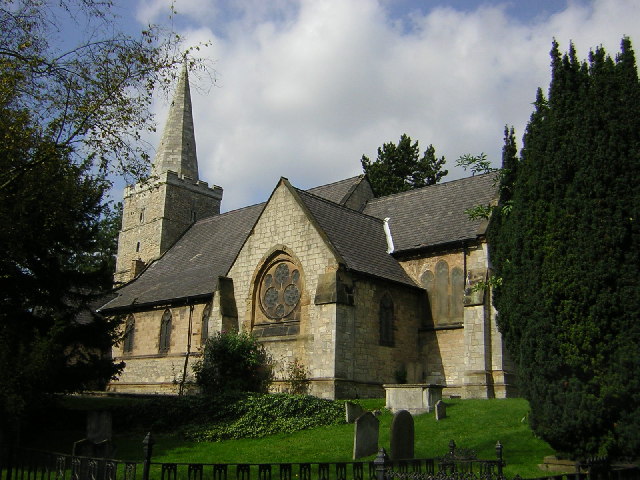
malby-churchOnce he’d rescued his “pilgrims,” Steinarr escorted them to the nearest village of any size that was properly along their route—Maltby, So. Yorkshire—even though he had to veer well north to do so. In the village, which dates back to ancient times, Marian might have noted the remains of several Roman roads that ran through the village, which was surrounded by rich farmlands. The current church building dates back only to 1859, but the square-topped tower you can see in the picture dates back to Norman times and would have been watching over Steinarr and Marian’s first kiss.

Next up: Headon and the Lady Well

Lisasigpink

Photo of St. Bartholomew’s Church, Maltby, by Richard Croft. Original work and Creative Commons License info can be found here.
Switch to Day Switch to Night